

Metal roofing has become one of the fastest-growing home improvement upgrades in North Carolina and South Carolina, especially as homeowners deal with rising energy costs, unpredictable storms, and roofs that don’t last as long as they used to. Yet despite its popularity, metal roofing still comes with a lot of outdated misconceptions—most of which were true decades ago but no longer apply to modern metal roofing systems.
If you’ve been on the fence about switching to a metal roof, here are the 7 biggest myths that homeowners still believe—and the truth behind them.
Myth #1: “Metal roofs are loud when it rains.”
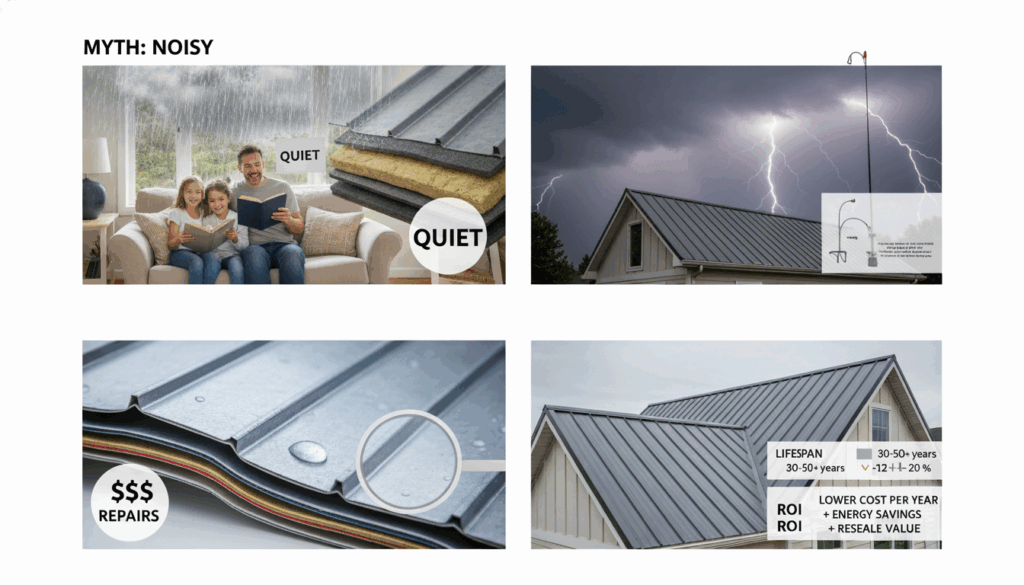
This is the most common myth, and it stems from metal barn roofs and old tin roofs with no insulation underneath. Modern homes are built completely differently.
The truth:
A properly installed metal roof is just as quiet as a shingle roof, if not quieter.
Why?
-
Today’s metal roofs are installed over underlayment, decking, and sometimes attic insulation
-
Multiple layers absorb sound
-
Standing seam panels are secured tightly, eliminating rattling
Inside your home, you won’t hear the “ping ping” people imagine. In fact, many homeowners report that rain actually sounds softer.
Myth #2: “Metal roofs attract lightning.”
This misconception scares many homeowners, but it’s not based on any real science.
The truth:
Metal roofs do not attract lightning.
Lightning is drawn to the tallest object in an area, not the material it’s made from. Trees, chimneys, and power poles are far more likely to be struck.
If lightning ever does hit your home, a metal roof is actually safer than shingles because:
-
Metal disperses energy
-
It’s non-combustible
-
It reduces the risk of fire
So not only does metal not attract lightning—it’s one of the safest roofing materials during a storm.
Myth #3: “Metal roofs rust.”
People often picture rusty barns or old corrugated farm metal. Modern metal roofing is nothing like that.
The truth:
High-quality metal roofs are designed not to rust.
They’re made with:
-
Galvanized or galvalume steel
-
Protective zinc-aluminum coatings
-
High-grade paint systems that resist corrosion
This advanced layering protects the roof from moisture, salt air, and oxidation. That’s why metal roofing is one of the best choices for coastal areas like Wilmington, Myrtle Beach, or Charleston.
Myth #4: “Metal roofing makes your home hotter.”
Homeowners sometimes assume metal “heats up” because it’s a reflective material, but the opposite is actually true.
The truth:
Metal roofing helps keep homes cooler, not hotter.
How?
-
It reflects solar radiant heat rather than absorbing it
-
Many metal roofs come with ENERGY STAR-certified coatings
-
Attics stay cooler, reducing AC usage
-
Dark colors can still be reflective with modern paint technology
Most homeowners see 20–40% lower cooling bills after switching to metal—especially in hot Carolina summers.
Myth #5: “Metal roofs are too expensive.”
While metal roofing costs more upfront than asphalt shingles, the long-term value is dramatically better.
The truth:
Metal roofing is one of the most cost-effective home upgrades over its lifetime.
Consider:
-
Shingle roofs last 12–18 years
-
Metal roofing lasts 40–70 years
-
Metal requires fewer repairs
-
Insurance companies often give discounts
-
Energy savings add up year after year
When you add these factors up, the lifetime cost of a metal roof is far less than replacing shingles 2–3 times.
Myth #6: “Metal roofs look too ‘industrial’.”
This was somewhat true decades ago—but today’s metal roofing is incredibly stylish and customizable.
The truth:
Metal roofing offers more design options than most people realize, including:
-
Dozens of colors
-
Matte, gloss, and textured finishes
-
Panels that mimic shingles, slate, or tile
-
Barn-style, rustic, modern, or traditional looks
-
Standing seam for a sleek, clean appearance
Whether your home is a ranch, Colonial, Craftsman, farmhouse, or beach house, there’s a metal roof that fits perfectly—and often improves curb appeal.
Myth #7: “Metal roofs dent easily from hail.”
Homeowners worry about hail damage, especially in areas that occasionally get severe storms. But modern metal roofing is built to withstand impact.
The truth:
Metal roofing is significantly more impact-resistant than shingles.
-
Many metal roofs have a Class 4 impact rating—the highest available
-
Hail tends to bounce off instead of cracking or shattering shingles
-
The flexible yet strong structure prevents damage
While extremely large hail can dent almost anything, metal roofs are still the best option for long-term protection and far outperform asphalt.
The Bottom Line: Modern Metal Roofing Is Smarter, Stronger, and More Efficient
Most myths surrounding metal roofing come from outdated information or old-style barn metal. Today’s metal roofing systems are engineered for modern homes, Southern weather, and long-term protection. They’re quiet, stylish, energy-efficient, and built to last for decades.
As homeowners in NC and SC continue looking for more durable, cost-effective solutions, metal roofing has become one of the smartest investments you can make.